
AIARE Level 2 Avalanche Course - Analyzing Snow Stability & Avalanche Hazard
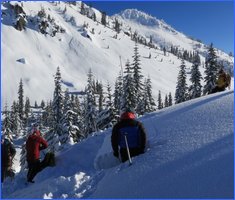
Course: AIARE Avalanche Level 2
Area: Leavenworth, WA & Central Cascades Backcountry
Winter 2026-27 Dates:
- Dec 19-20, 2026
- Jan 9-10, 2027
| Cost: |  |
$625 ($575 before Nov 15) |
Ready to Sign up?
REGISTER ONLINE NOW
»
Cost Does Not Include
Transportation to/from the course area, personal food, personal climbing equipment, trailhead parking pass fees (if needed), additional books that you may choose to purchase.
Client to Guide Ratio: 6:1
Expedition PDFs
Equipment List »


This hybrid AIARE Level 2 program involves self-paced online study, and two 2-hour group Zoom sessions in advance of 2 full field days. This 24-hour course provides backcountry travelers with an opportunity to advance their decision-making skills in more complex situations, such as serving as the group leader, developing a travel plan in areas without an avalanche forecast, or traveling into more complex terrain.
The online learning portion of the course lets you take quizzes to check for understanding, which you can retake to help cement this knowledge. The time spent with NMS instructors, both on Zoom and in person on the field days, allows you to ask specific questions of deeply experienced instructors who will be leading the group through hands on skills practice.
The two Zoom lectures will run from 5-7 PM (on the two consecutive Thursday evenings before your first field day) and bridges the information from the online learning, and your previous level 1, to your hands on time in the field.
The AIARE Level 2 course builds on the introductory avalanche hazard management model introduced in the AIARE level 1 and adds evaluation of factors critical to stability assessment.
The classroom sections of the course are based at Stevens Pass Mountain Resort, and we use a variety of field locations, allowing us to observe snowpacks at different elevations. Most of the training takes place in the backcountry and requires participants to move efficiently in that environment. AT skis or a split board with skins are required for backcountry travel.
AIARE Level 2 Avalanche Course Itinerary
The goal of this level 2 is to take the knowledge gained from previous courses and experience and hone in on appropriate application in the field.
Pre-trip Study: You will be sent a link to the online learning upon registration. The online learning component need to be completed in advance of the course and takes about 6 hours to complete. This material remains accessible for 1 year after your course.
Thursday Evening Zoom Sessions: On the 2 consecutive Thursday evenings, in the 2 weeks before your first field session, your instructor will host an evening Zoom meeting from 5-7 PM. The goal is to continue to develop, refine and elevate your pre-trip planning process for travel through avalanche terrain. The first session is far enough in advance that we will not have a good feel for current conditions. This allows us to come up with tour options based on our objectives, that we will then be able to choose from once we have a better sense of the current weather & snowpack, 2 days prior to your field session. This is also an opportunity to ensure everyone in the group is ready for the upcoming field days, knows where/when to meet, etc.
Day 1: We meet inside at Stevens Pass Mountain Resort at 7:30 am and begin by reviewing the current avalanche & weather forecasts, checking the overnight weather observations, and confirming our plan before heading out for a backcountry tour.
We conduct a tour, executing and adjusting our plan as dictated by current conditions. On the tour, we make observations relevant to the avalanche problems we are currently experiencing and begin to think about appropriate tours for the following day. We end the day with a short planning session in preparation for the next day's tour. (7:30 AM - 4 PM)
Day 2: This day will utilize different terrain than the area where you toured the day before and will build on our understanding of the current and future snowpack as we undertake a longer tour. The weather and our tour choice will determine where we meet this morning. If it works for the group we might venture a little further east of Stevens Pass (potential zones include Lake Wenatchee area, Blewett Pass or Mission Ridge) to observe different snowpacks. Our goal is to have you back to your car and on your way home by 4 PM. (7:30 AM - 4 PM)
AIARE Level 2 Student Learning Outcomes
At the end of the AIARE Level 2 course, the student should be able to:- Differentiate where specific avalanche hazards exist within the landscape and identify avalanche terrain where consequences may be more severe.
- Use and interpret weather, snow, and avalanche observations to locate appropriate terrain prior to entering and while in the field.
- Demonstrate leadership skills within a small team that includes facilitating small group discussion, promoting appropriate terrain selection, and utilizing simple risk management strategies.
- Implement a basic forecasting framework that can be used in conjunction with and in the absence of local supporting avalanche information.
Instructional Sessions (24 hours including both class and field) include:
- Advanced snow stability analysis
- Avalanche forecasting
- How to observe and record weather, snowpack, and avalanche activity
- Detailed analysis and recognition of avalanche terrain
- Faceting; near-surface and near-crust faceting
- Formation of surface hoar and persistent weak layers
- Standard Observation guidelines and recording formats for factors that influence or indicate snow stability.
- How to make a snow stability analysis
- Using a forecasting framework
- Increasing your understanding of avalanche release and triggering mechanisms
- Information gathering including: site selection and relevancy, spatial variability, and slope tests
Student Prerequisites
Students must have taken both the AIARE L1 and the AIARE Avalanche Rescue Course to participate in this program. We will be offering the Avalanche Rescue Course the day before each scheduled AIARE L2 to ensure you enter the course with current rescue skills. If you prefer, you can take the Avalanche Rescue Course on one of the other dates offered in advance of your course. Participants must be on an AT setup, Tele Setup, or split board. You should be able to skin uphill and move efficiently in the backcountry, as the course involves a decent amount of backcountry travel.More about the AIARE L2
It has been many years since the AIARE pro-rec split, and we are very happy with how these courses have developed. In the past, we felt that our Level 1 students lacked the ideal opportunity to continue their avalanche travel training. The previous Level 2 was a bit too tech-heavy for your average recreational user, but the previous Level 1 lacked an effective way to provide continuing education for Level 1 graduates. The new AIARE Level 2 builds significantly on material covered in the AIARE L1 and serves as both a good refresher and powerful opportunity to expand your understanding (through mentored application) of how weather, snowpack, and avalanche processes relate to observations and travel in avalanche terrain. If it has been a few years since you completed your AIARE L1 and you want to refresh your skill set and take it to the next level, then the AIARE L2 is a logical choice.AIARE Level 2 Equipment
Recommended equipment is covered in detail in our equipment list, but there are a few items we would like to highlight. If taking the Level 2, you should own a beacon, shovel & probe. We also rent these items. Ideally, your probe will have measurements in 1-cm graduations, allowing it to stand in for your ruler.We will give you a field book for recording data that includes useful cheat sheets to remind you of the most commonly used items from the SWAG manual published by the US Forest Service. You can also consider picking up a copy of the 3rd edition of the Avalanche Handbook as well as a copy of the snow, weather, and avalanche observation and recording guidelines (SWAG). You can view the SWAG here and you can purchase the SWAG here.
Much of the snow study equipment is listed as optional. The Rec level 2 is focused on more advanced application of decision making skills learned in the L1. As such snowpack observations are not as central as they would be on a Pro level course. That said we include a list of appropriate tools for those who would like to build their own snow study kit as there will be opportunities to put these to use in the field with your instructor.
A basic snow study kit typically includes: a snow thermometer (Celsius required; digital is nice), a Loupe or magnifying glass (10x to 20x magnification), 2 mechanical pencils, and a Crystal screen.
Other items you might consider include: a compass, altimeter, inclinometer, snow saw, and rutschblock cord. You can bring what you have to the course and then decide what to buy at the end when you have had a chance to see all the latest and greatest gear during the course.
Snowmetrics.com is a great place for purchasing purpose built snow measurement equipment if you are interested.
Logistics
You must provide your own food, lodging, and transportation during the course. Most days will involve some indoor work in Leavenworth, with field sessions at a variety of locations in the surrounding mountains.Lodging Options
Lodging is not included in the course, but Leavenworth does have a wide variety of lodging options. There is also a possibility that participants in the course may be able to host people from outside the area if you are looking for less expensive lodging options and are open to a bit of couch surfing. The following are some of our preferred lodging options.High End Accommodations near Leavenworth
Sleeping Lady Retreat and Conference CenterHotel Pension Anna
Enzian Hotel
Moderately Priced Accommodations near Leavenworth
Howard Johnson Inn - LeavenworthIcicle Inn
Wedge Mountain Inn
Rental Space in our friend's mother-in-law apt
Der HundehüttePre-Course Quiz
This information will be sent to you along with the pre-trip materials, but you will be asked to complete a pre-course quiz and bring it to the start of the course. The idea behind this is to have you review your own knowledge of AIARE Level 1 prior to the start of the course. View the AIARE Level 2 Pre-Course Quiz.Custom Programs
If you have a group of 2 to 12 people, we can often put together a custom date. Weekends tend to fill quickly, and we often do not have sufficient staff to conduct custom programs on weekends, but we can generally put together off-weekend custom programs for your group. Past groups include search & rescue personnel, military groups, climbing clubs, youth groups, and groups of friends that travel in the backcountry together. The cost for custom programs is based on the number of people that register, with the final cost approaching our set-date cost if you have at least 5-6 people. Best to just give us a call at 509-548-5823 to discuss your custom program.

