
Guided Mount Rainier Climb - Emmons Route
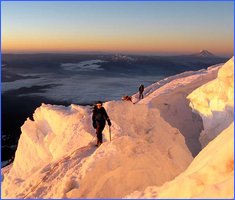
Mountain: Mt Rainier (14,410')
Route: Emmons Glacier Route
2022 Dates:
- June 26-30, 2022 (FULL)
| Cost: |  |
$2495 per person |
Ready to Sign up?
REGISTER ONLINE NOW
»
Cost Does Not Include
Meals, transportation to/from Mt. Rainier National Park, personal climbing equipment, National Park Climbers Recovery Fee & Park entrance fee ($53).
Client to Guide Ratio: 2:1
Expedition PDFs
Equipment List »


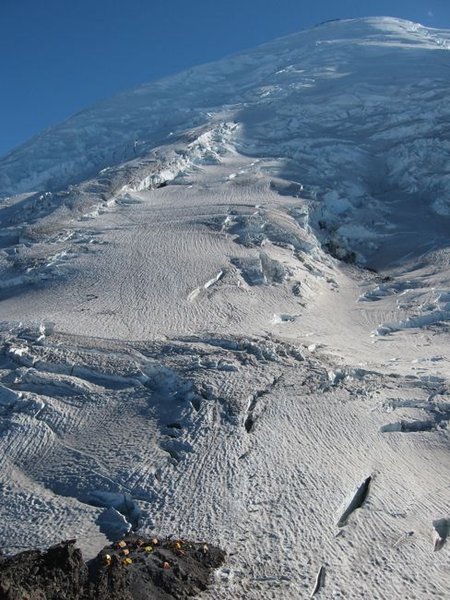
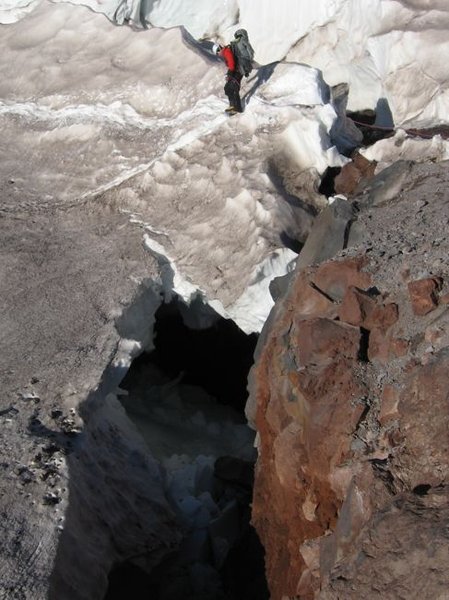
This ultra-private, four to five-day guided program will be take place on the East side of Mt. Rainier on the the less frequented Emmons Glacier Route. On most trips we can do the climb in 4-days, but we have built in a 5th day as a contingency day in the event that we need an extra weather day to make our summit bid. As we are limited to 4 climbers and 2 guides, participants are in for a very customized climbing program on a mountain that is very special to us. Starting at 4,400 ft. at the White River Campground, we will climb 10,000 vertical feet to reach Columbia Crest, the true summit of Mt. Rainier.
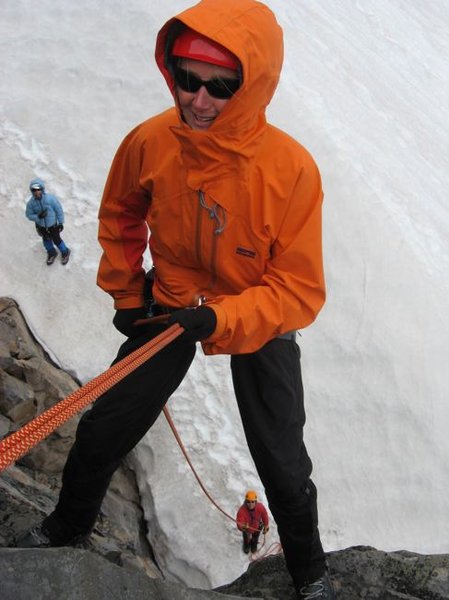
In addition to making a summit bid, this climb of Mt. Rainier is organized as a basic mountaineering seminar and involves training in use of the ice axe and crampons, crevasse rescue, ice climbing, and other basic skills needs for climbing big glaciated peaks. This program would serve as a very good component for climbers looking to train for a Denali Expedition or Aconcagua Expedition, both other mountains offered by the Northwest Mountain School.
Guided Mount Rainier Climb Itinerary
Day 1: We will meet outside the park for an equipment check before driving to the White River Ranger Station to check in for our climb. From the White River Ranger Station we will drive to the White River Campground and begin our climb with a hike through a beautiful forest before reaching Glacier Basin at around 6000'. About an hour's hike above Glacier Basin we will gain the toe of the Inter Glacier and spend some time practicing ice axe self-arrest, and becoming familiar with crampons, and the climbing rope. The evening will be spent reviewing climbing knots, and other basics needed for our upcoming ascent of Mt. Rainier.Day 2: After an early start we will ascend the Inter Glacier to around 9000' before descending a steep slope to the edge of the Emmons Glacier. Our goal for the day is to reach Camp Schurman, an excellent camp at around 9,460 feet with a good water source. This camp has several nearby crevasses, which are perfect for crevasse rescue practice and doing some vertical ice climbing. The trip to the Castle is an opportunity to hone our crampon and rope travel skills, which will be essential on summit day.
Days 3: First possible summit day. Our summit day usually takes about 12 hours from camp and is no easy task. Normal people who have the desire and have done their training will comfortably make it up and down, but nobody ever has what would be described as a casual trip. If all goes well we will summit Rainier early and then make the trip back down to our high camp while things are still solid on the glaciers along the way.
Day 4: On our final day we will pack up camp and head back to the trailhead for a celebratory cheeseburger and a hard-earned cold drink.
Day 5: Contingency day in the event that we are forced to climb on day 4 if the weather does not cooperate on day 3. We need to use the 5th day about half of the time.
Qualifications for Climbing Mt. Rainier
You need no previous climbing experience to do this climb, but you do need to be in very good condition and must be able to carry a backpack weighing as much as 50 lbs. People very often underestimate the difficulties required to climb Mt. Rainier and can be very disappointed if their physical fitness and stamina do not add up to reaching the summit. In the words of a sage mountain guide, "You cannot overtrain for a climb of Mt. Rainier." Please contact the office for advice on training or to discuss the difficulties of the trip before committing to your spot.Logistics
If coming from outside of the Pacific Northwest you will want to fly into Seattle-Tacoma International Airport and rent a car to get to Ashford, WA, meeting point for our climb of Mt. Rainier. If you need to rent an ice axe, crampons, plastic boots, etc. you should contact Feathered Friends in Seattle (888-308-9365) to reserve any items that you need for the climb. You will want to arrive on the day before your climb starts and depart the day after your climb ends. Additional details will be mailed to you upon reserving your spot on this trip.Training to Climb Mt. Rainier
It has often been said that you cannot over train for a climb of Mt. Rainier. Over the years we have taken hundreds of people to the summit and had many other people unable to make it to the top. Those that consistently succeed seem to have a good basic level of fitness and above all have the ability to keep moving uphill at about 1000' feet per hour for 7 to 8 consecutive hours. Your best training is going to be walking uphill with weight on your back. This can be accomplished by backpacking, AT skiing, or other mountaineering programs. If you do not live near hills or mountains, then we suggest a mixture of running, swimming, and biking all with an emphasis on going for several hours at a time. A guided climb of Mt. Rainier takes much of the pressure off with regards to decisions about route-finding, weather conditions, and other details related to the climb, but it does not lower the bar for the fitness required to make it safely up and down Rainier. Be sure to contact us directly before your climb for full details on training for your Rainier climb.Alternatives to climbing Mt. Rainier
Guided climbs of Mt. Rainier are regulated by the National Park Service and tend to fill very quickly. The 3 major concessions split 3600 spaces per year. 15 non-concession companies each get 4 spaces per year (60 spaces total). The reality is that if you can not get on with a concession you need to be very lucky to get one of the other companies 4 spaces. Many people are not aware of the other great mountains to be climbed in the Pacific Northwest. While there are no other peaks over 14,000 in the State of Washington, there are dozens of peaks ranging from 8000' to 12,276' that offer physical climbing challenges equal to Mt. Rainier and generally greater than one of the Colorado 14'ners. What makes these lower peaks so special is that they generally have much lower trailheads, a steeper overall climb, and heavy glaciation, making them the ideal training ground for big mountains outside the US or in Alaska, or extraordinary outings in themselves. All of these peaks are much less crowded than Mt. Rainier. The following list should give you an idea of the possibilities. Feel free to call us at 509-548-5823 to discuss alternate climbs if you preferred Mt. Rainier date is unavailable.Mt. Adams Climb (12,276')
- South Spur (6,675' elevation gain, 30 degree climbing, 1-3 days)
- North Ridge (7,676' elevation gain, 40 degree climbing, 2-3 days)
- Adams Glacier (7,676' elevation gain, 45 degree climbing, 2-3 days)
- Avalanche Glacier (6, 675' elevation gain, 40 degree climbing, 2 days)
- Link to: Mt. Adams Climbs
Mt. Baker Climb (10,781')
- Coleman-Deming (7,075 elevation gain, 35 degree climbing, 2-3 days)
- Easton Glacier (7,575' elevation gain, 30 degree climbing, 2-3 days)
- North Ridge (7,075 elevation gain, 70+ degree climbing, 2-3 days)
- Link to: Mt. Baker Climbs
Glacier Peak Climb (10,541')
- White Chuck Glacier (8,241' elevation gain, 30 degree climbing, 4-5 days)
- Link to: Glacier Peak Climbs
Mount Shuksan Climb (9,127')
- Sulphide Glacier (6,627' elevation gain, 30 degree climbing, 2-3 days)
- Fisher Chimneys (4,427' elevation gain, 50 degree climbing, 2-3 days)
- White Salmon Glacier (4,427' elevation gain, 50 degree climbing, 2-3 days)
- Link to: Mt. Shuksan Climbs

